
Environmental, Social, and Governance (ESG) strategies have become foundational to how responsible companies operate. From net-zero commitments to supply chain audits, ESG teams are under growing pressure to deliver measurable progress – and real impact.
Yet while environmental and governance metrics have become increasingly standardized, the “S” in ESG—the social dimension—remains the most complex and least understood.
According to a Stanford Social Innovation Review article, the absence of a clear standard and difficulties in obtaining reliable data have made social metrics difficult to integrate meaningfully. Most ESG frameworks focus on econometric measurements that may indicate increases in community benefits, but these typically capture only gross material gains and overlook the broader range of non-material benefits that contribute to wellbeing. Even when measuring material benefits, such frameworks often fail to account for the equity of their distribution, an oversight that can significantly undermine community wellbeing.
How are your sustainability efforts actually shaping the well-being of the people and communities on the ground?
The World Happiness Report 2020 and Sharecare’s Sustainability & Well-Being analysis confirm a powerful trend: countries that perform well on the Sustainable Development Goals (SDGs) also report higher levels of subjective well-being—people feel healthier, more secure, and more satisfied with their lives.
This correlation is especially strong when it comes to areas like access to healthcare, education, broadband, and transportation. In other words, well-being isn’t just a desirable outcome of sustainable development—it’s one of the best indicators that sustainability is actually working.
The Environmental Paradox: When Progress Doesn’t Feel Like Progress
However, the same data also reveal a critical contradiction. The World Happiness Report highlights that SDG 12 (responsible consumption) and SDG 13 (climate action) are sometimes negatively correlated with people’s reported well-being.
Why? A major reason lies in how these strategies are implemented. Top-down sustainability efforts often fail to involve the communities they impact, leading to misalignment of communications, assumptions, cross communications, failure to build trust and consensus and even unintended harm.
Consider wildlife conservation: in many regions, protected areas have been established without local consultation, restricting access to forests, grazing lands, or rivers. These interventions may preserve biodiversity, but they can also lead to resentment, resistance, and the erosion of trust. Ultimately, they risk undermining both community well-being and the long-term success of sustainability goals.
This is the paradox: environmental gains don’t always translate into better lives—unless people are part of the solution. Sustainability must be co-designed with communities, not simply delivered to them.
What’s Missing in ESG? A Metric for Community Well-being
As more companies and governments look to align environmental progress with human outcomes, they’re discovering a critical gap.
This is where OneNature’s Wild Happiness Index (WHI) comes in.
Introducing the Wild Happiness Index: From Insight to Impact
The Wild Happiness Index is a structured, field-tested framework designed to measure the lived experience of sustainability at the community level. It combines subjective and objective indicators to fill the gap traditional ESG tools leave behind.
Rather than replacing standard ESG metrics, WHI enhances them—surfacing the human stories behind the data and helping ESG teams understand not just what’s happening, but how it’s being felt.
With the Wild Happiness Index, ESG teams can:
-
Map well-being across mental, physical, social, economic, and environmental dimensions
-
Identify trade-offs and unintended consequences before they escalate
-
Align progress on SDG 12 and 13 with SDG 3 (Good Health and Well-being)
-
Monitor changes over time with a locally informed, people-centered lens
A Strategic Advantage for ESG Leaders
Whether you work in infrastructure, conservation, extractives, tourism, or beyond, a well-being approach offers clear value:
-
Stronger trust and social license
-
More resilient programs
-
Better storytelling for investors and partners
-
Reduced risk of project failure
Measure What Truly Matters
True sustainability doesn’t just protect the planet—it helps people thrive. That means moving beyond checklists and compliance to truly understand and respond to the lived experiences.
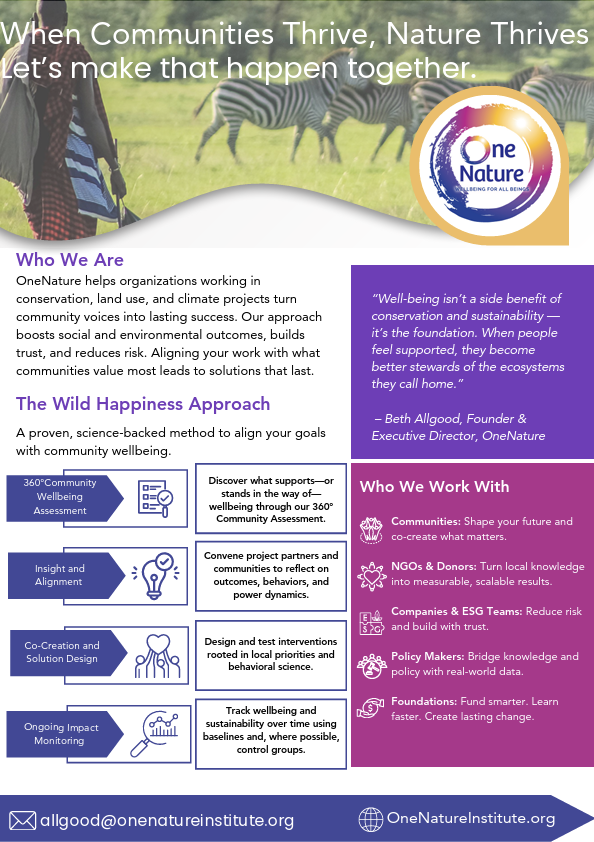
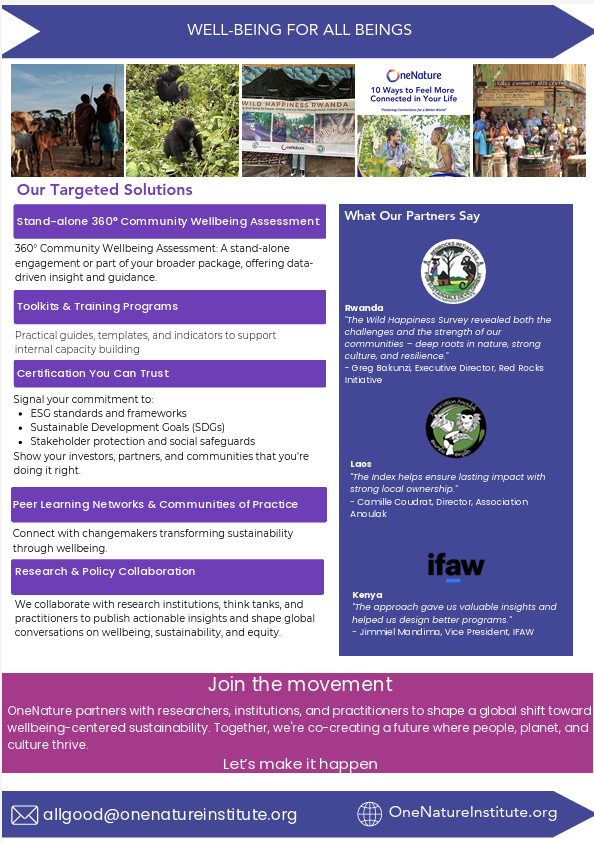
To see how the WHI can enhance your ESG strategy, download OneNature’s overview: OneNature April 2025 Two-Pager (PDF)
And explore our full range of services and solutions to learn how we can support your journey toward human-centered, measurable sustainability.