
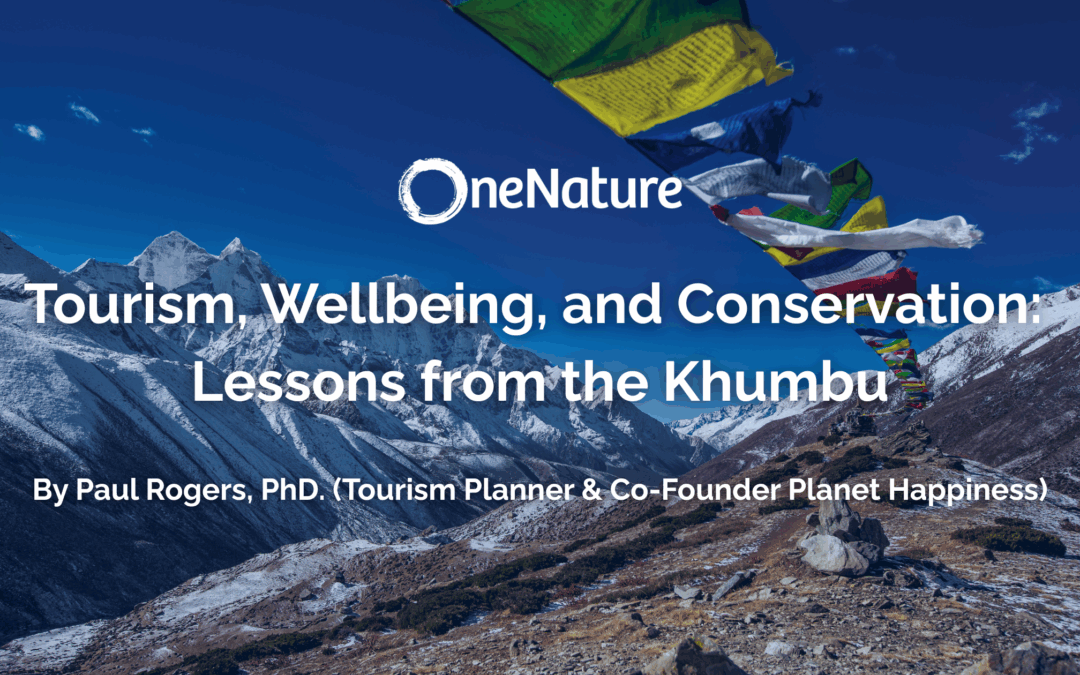
At OneNature, we believe that lasting conservation and tourism success begins with people—and with data that reflects their lived experience. That’s why we’re proud to collaborate with global partners who share this vision. In this guest piece, longtime collaborator Paul Rogers reflects on his recent presentation at the 2025 ISQOLS Conference and the release of IUCN’s latest Issues Paper, spotlighting the Khumbu region of Nepal. From Sagarmatha National Park to local wellbeing surveys and a powerful new data dashboard, this story shows how wellbeing-centered tourism can benefit both communities and ecosystems.
With gratitude,
The OneNature Team
I’m writing this from Luxembourg, just after presenting new work on tourism and wellbeing in Nepal’s Khumbu region at the 2025 ISQOLS Conference. It’s been a rewarding moment personally and professionally to share how this iconic region, home to Sagarmatha (Mt. Everest) National Park, is leading the way in linking tourism, conservation, and community wellbeing.
The Khumbu is also one of the featured case studies in a new IUCN Issues Paper I was invited to co-author with excellent colleagues from the IUCN World Commission on Protected Areas Tourism and Protected Areas Specialist Group (WCPA TAPAS). The paper makes a strong case that tourism, when done right, can be a force for conservation and resilience. We focus on three strategic goals:
- Making sure tourism revenues directly support conservation
- Using tourism to strengthen local communities
- Building better, more collaborative governance across all sectors
For me, seeing the Khumbu included isn’t just professional validation, it’s personal given my 30+years association with the region – a region that shows the world what’s possible when tourism supports both people and nature.
A New Tool for the People of the Khumbu
I’m currently engaged with the Khumbu Pasang Lhamu Rural Municipality to bring community wellbeing into the center of tourism planning. Together we deployed a baseline community specific Happiness Index survey in the region in 2022. Now we have redeployed the survey in 2025 in partnership with OneNature to see what has changed and to inform the tourism planning process now underway.
OneNature’s new Wellbeing Dashboard, is a compelling user-friendly tool that brings the survey data to life so that community leaders, planners, and residents can see what’s working, what’s not, and where to focus their efforts to enhance community wellbeing. I’ll be sharing the refined version with community leaders back in Nepal next month.
A Roadmap
The full IUCN paper is now out. It offers a clear, evidence-based roadmap for how tourism can move beyond buzzwords like “sustainable” or “nature-positive” and actually deliver on its promises—for biodiversity and for communities.
It’s grounded in policy, practice, and lived experience. I’m grateful to the co-authors, partners, and especially the people of the Khumbu for making this work possible.
Tourism can be more than just an industry. It can be a tool for fostering worldwide knowledge and understanding of the wellbeing agenda, to create thriving communities and thriving ecosystems – provided we listen, measure what matters, and design with care.
Read the full IUCN Issues Paper No. 07: https://lnkd.in/e8k6Gmz9
Thank you for reading
Paul Rogers, PhD., Tourism Planner & Co-Founder Planet Happiness