
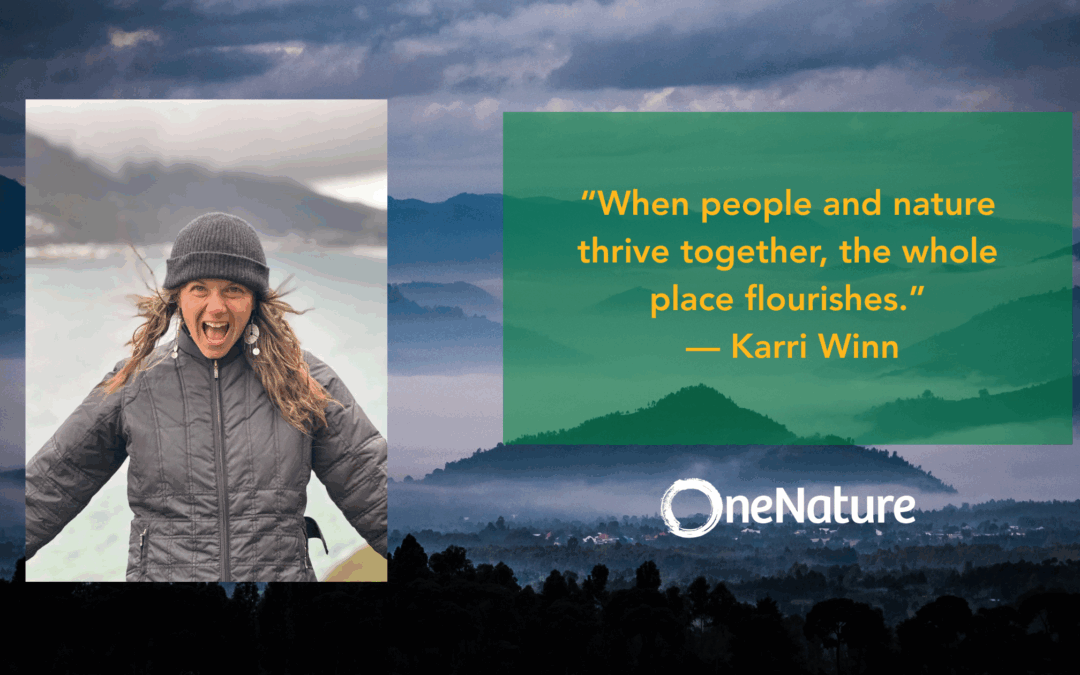
This week, we’re honoured to share a powerful field reflection from Karri Winn, a passionate advocate for regenerative tourism and inclusive innovation. Karri travelled with our team to Rwanda in October 2024 to help launch a Wild Happiness Survey with Red Rocks Rwanda, a community-based tourism initiative at the edge of Volcanoes National Park. In this guest post, Karri shares how the trip shaped her understanding of regenerative tourism, place-based wellbeing, and the profound possibilities of community-led travel.
By Karri Winn
In October 2024, I had the brilliant opportunity to travel to Red Rocks Rwanda with Beth Allgood. The purpose of the visit was to launch a Wild Happiness Survey in collaboration with Red Rocks – a dynamic hub of inclusive community and cultural innovation located on the edge of Volcanoes National Park. It’s also a shining example of a regenerative tourism destination.
I’m deeply passionate about the regeneration movement, but until that trip, I hadn’t fully understood the transformative potential of regenerative tourism as a part of that larger paradigm. Spending time with Red Rocks’ visionary leader Greg Bakunzi was eye-opening. Greg didn’t set out to build a “regenerative” tourism destination – he simply followed an aspirational purpose to enhance the wellbeing of his community.
By focusing on the potential of his place, Greg and his team have organically grown a local livelihood incubator, a community centre, traveller accommodation, and a culture innovation hub, using tourism as the catalyst for regenerative change. Launching the Wild Happiness Survey in this community felt like a natural next step in capacity-building and meaning-making.
Red Rocks Rwanda has a vested interest in the wellbeing of Volcanoes National Park. When people and nature thrive together, the entire place flourishes. Striving for wellbeing not only protects people – it protects tourism, drives the local economy, and honours the Mountain Gorillas.
🌱 Understanding Regeneration
The regeneration paradigm brings a bold, inclusive vision for the holistic wellbeing of people, cultures, places, and nature. At its core, regeneration means to regrow and renew. As an emerging cross-sectoral movement, it embraces:
-
An ecological worldview
-
Living systems thinking
-
A deep focus on place
-
And, crucially, recognition that people and nature are intrinsically connected within a web of life
A regenerative mindset will look different in every place—because cultures and communities make sense of their relationship with nature in infinitely diverse ways. What remains consistent is a focus on whole-systems wellbeing, enhancing potential, and an aspirational purpose rooted in care.
🌍 The Role of Tourism
The global travel and tourism industry is vast—accounting for 10% of global GDP and jobs. As more destinations shift to regenerative tourism, especially in culturally rich and ecologically sensitive areas, there is a real opportunity to grow wellbeing alongside efforts to restore ecosystems, stabilize climate, and revitalize local economies.
-
Tourism businesses can actively support conservation
-
Travellers can invest in biodiversity stewardship
-
Communities can co-lead transformation
This is a reciprocal, transformational, and mutually beneficial relationship.
🌿 A Living Example: !Khwa ttu, South Africa
In May, I visited !Khwa ttu – The Embassy of the San, located on an 850-hectare nature reserve in South Africa’s Cape Floral Kingdom – a biodiversity hotspot. Tourism now funds about half of their budget.
Since buying an old wheat farm in 1999, !Khwa ttu has:
-
Restored the natural Fynbos ecosystem
-
Built a thriving cultural centre honouring San heritage
-
Offered residential youth training and livelihoods
-
Created multi-sensory museum experiences
-
Designed bespoke eco-accommodation and a slow-food restaurant inspired by regional flavours
I felt completely enveloped by the embrace of their culture, their land, and their values. It was deeply moving and unforgettable.
📌 So, What Is Regenerative Tourism?
Regenerative tourism destinations embed ecological and cultural vitality into every business operation. The place itself is the map—each destination is unique. Tourism becomes a tool for:
-
Growing life and opportunity
-
Partnering with local communities
-
Treating nature as a stakeholder
-
Listening deeply to the needs and rhythms of the place
-
Stewarding the planet, one place at a time
Ultimately, regenerative tourism is a values-led vision: one where tourism is not just sustainable, but restorative, reciprocal, and deeply rooted in care.
📚 Learn More:
🎧 Watch: Akamaro K’igiti by Koreta Bashima – a video I produced with Red Rocks Volcanoes Production Studio
About Karri Winn
Karri is currently studying Inclusive Innovation and Regenerative Tourism at the University of Cape Town Graduate School of Business. Her work lives at the intersection of sustainability, community development, business, human potential, somatic movement, and systems thinking.
Connect with Karri at Culture Convivium