
by John Waugh Executive Director OneNature Institute
Most of us, when we notice something broken, reach for the nearest fix. A species is declining — manage it. A community is struggling — incentivize it. A forest is disappearing — fund its protection.
These are sensible impulses. But what if the tools we are reaching for are part of what broke things in the first place?
That is the uncomfortable question at the heart of why OneNature works the way it does.
Some scientists use the term metacrisis to describe what is happening in the world right now — not simply one crisis, but a tangle of crises feeding into one another: climate disruption, biodiversity collapse, economic instability, geopolitical fractures, and ethnic strife. What makes it a metacrisis, rather than a collection of separate problems, is that these challenges are interconnected and self-reinforcing. And perhaps most importantly, they share a common root.
Modern societies operate on an assumption — so deep it is almost invisible — that the world is fully knowable and controllable. In this view, complex systems such as forests, fisheries, and communities can be broken into parts, measured, optimized, and managed.
Philosopher Severin Sjømark describes the problem as a “mismatch between how reality unfolds and how we as moderns have learned to relate to it.” We assume consequences can be calculated and courses corrected. But living systems do not work that way. They are unpredictable, irreversible, and deeply relational.
Conservation offers a telling example. Even well-intentioned conservation programmes often treat ecosystems — and the people who depend upon them — as variables to be managed toward a desired outcome. When those programmes encounter unexpected turbulence, as they inevitably do, the management playbook offers little real guidance.
That is the blind spot: we have optimized wisdom and judgement out of the system, and then are surprised when algorithms cannot replace them.
Local and Indigenous communities have spent centuries practising a different kind of knowledge — one rooted in relationship, reciprocity, and accumulated experience rather than control. The question worth sitting with is whether the dominant worldview can even recognize that as knowledge, or whether it has already been dismissed as beside the point.
Holding Space for What We Don’t Know
If our usual toolkit for addressing environmental problems is itself part of the problem, what do we do instead?
OneNature’s answer begins with something that sounds almost too simple: listen.
Not with an agenda.
Not with a solution already in hand.
Just listen.
That practice is harder than it sounds, especially for organizations with missions, timelines, and funders expecting measurable results. Most sustainability projects arrive in a community with a predetermined logic: here is the problem, here is the intervention, and here are the metrics we will use to define success.
Communities become stakeholders to be managed, their knowledge useful only insofar as it fits within the project’s existing framework.
OneNature’s Wild Happiness approach works differently. Before designing anything, we ask communities what wellbeing, happiness, and security actually mean to them — on their own terms and in their own language.
This is not simply good manners. It reflects something deeper: a recognition that different cultures genuinely hold different understandings of what a good life looks like, and that these differences carry real knowledge about how to live sustainably within a place over long periods of time.
Scholar Donna Haraway writes about the importance of “staying with the trouble” — refusing both the false comfort of techno-optimism and the paralysis of despair, and instead remaining fully present to the messy, uncertain reality of our times.
This requires tolerating ambiguity, learning from perspectives that do not fit neatly into existing categories, and accepting that wisdom is not something that can simply be downloaded or scaled.
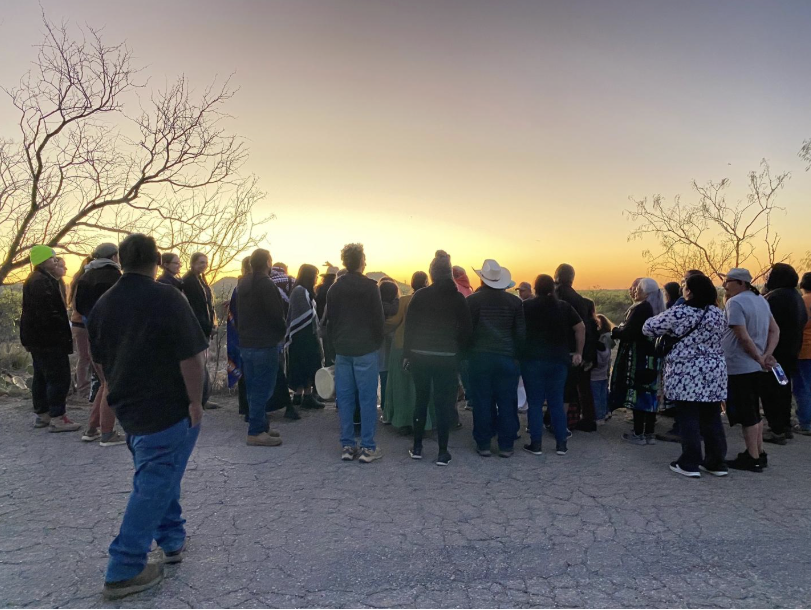
Photo Courtesy John Waugh Executive Director OneNature
This is why OneNature works at the intersection of human wellbeing and nature. Human communities and ecosystems are not separate systems to be managed in parallel — they are entangled. The health of one reflects the health of the other.
When communities are genuinely included in shaping the conditions of their lives, something changes: they become invested, not simply compliant. When sustainability is the goal — not merely a feature — this kind of investment becomes essential. Communities remain long after projects end.
Learning from Indigenous Peoples
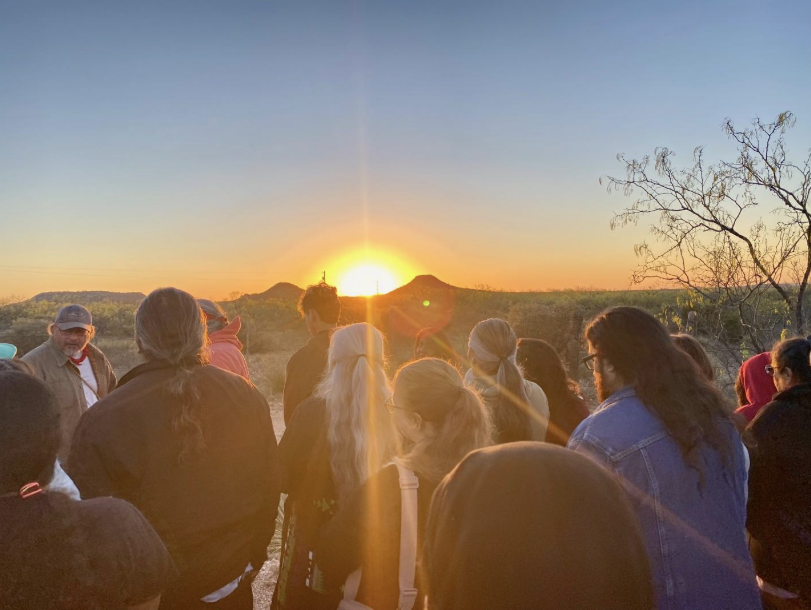
Photo Courtesy John Waugh Executive Director OneNature
Recently, OneNature has entered into dialogue with Indigenous groups in Texas, USA. What we are learning about wellbeing through Indigenous perspectives is both encouraging and deeply thought-provoking.
Some Indigenous traditions hold not only space, but also time, in profoundly different ways (see Remembering to Survive: Indigenous Wellbeing and Deep Time in Texas, February 2026). Understanding life — and civilization itself — in cyclical rather than purely linear terms, they recognize that the instrumental rationality and linear thinking of the current epoch must eventually exhaust themselves.
A softer landing may yet be possible if we can adopt a worldview that reintroduces reverence, humility, and responsibility for the privilege of participating in the miracle of life.
In April, I was honoured to be invited to the annual spring equinox ceremony of the Pakahua, the Lipan Ndé (Apache), and Comanche peoples. I do not pretend to be an initiate, nor is that my intention. One is born into this worldview. Yet there is a profound sense of fellowship extended to those who seek to understand more deeply and who join in reverently honouring the ancient rite of giving thanks for the changing seasons.
Can Indigenous peoples offer a practical pathway beyond the limitations and assumptions of late modernity’s dominant worldview?
In the near future, we will continue exploring the concept of biocultural ethics and will present a paper at the annual conference of the International Society for Quality of Life Studies in Lexington, Kentucky, this August.
As we deepen our understanding of wellbeing, we hope you will continue this journey with us.
Warm wishes,
John Waugh
Executive Director
OneNature Institute